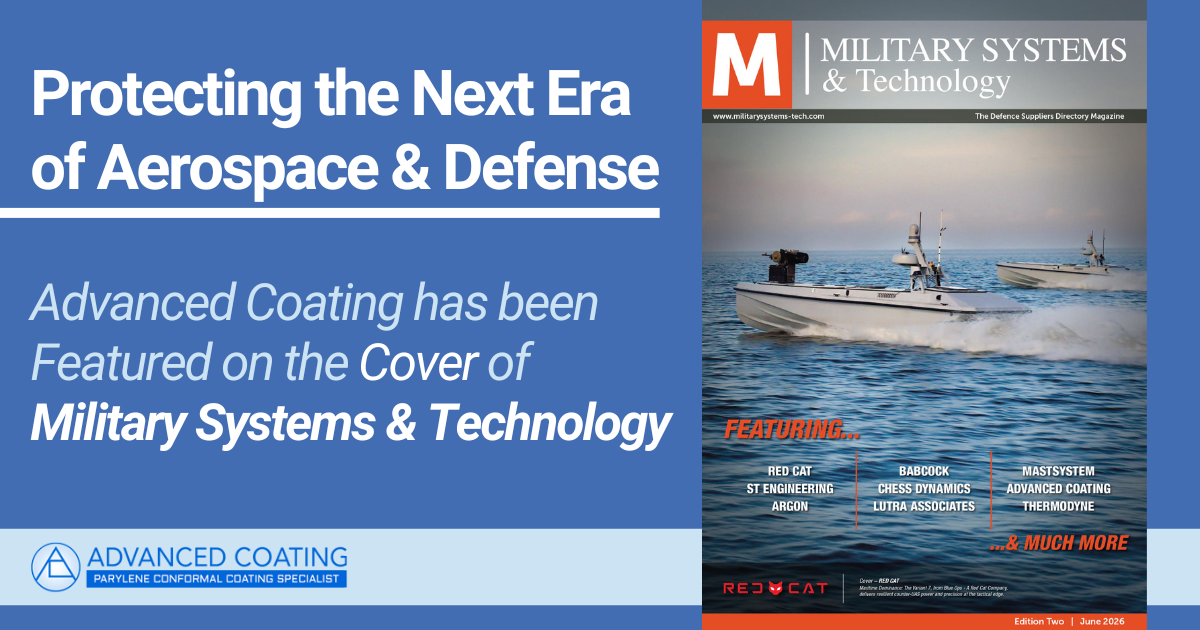
This post is based on a published Feature Article, originally published on Military Systems & Technology Magazine: Edition Two, June 2026.
In 2026, the aerospace and defense industry is no longer evolving at a measured pace. It is being rewritten in real time.
Traditional assumptions about warfare, force protection, and sustainment continue to be shattered by the speed of technological change. Across today's defense landscape, low-cost drones, autonomous systems, counter UAS requirements, predictive maintenance, and distributed manufacturing are no longer future concepts. They are present-day realities shaping procurement, production, and battlefield readiness.
From our vantage point at Advanced Coating in Rancho Cucamonga, California, these changes are not abstract. We see them directly in the expectations of aerospace and defense manufacturers who demand higher performance, faster turnaround, tighter process control, and greater resilience across every link of the supply chain. At the heart of this resilience is a specialized, mission-critical technology: Parylene conformal coating.
The Drone Revolution and the Need for Molecular Shielding
As drone technology proliferates and artificial intelligence moves from the battlefield into maintenance operations, production environments and service hangars alike are being transformed. The defense sector is asking more from materials, coatings, electronics, and manufacturing partners than ever before.
As Ernest Garcia puts it, "Drones are the biggest battlefield innovation in my generation. The fight back against a drone epidemic is underway. The last two years I've seen an explosion of autonomous and first-person-view drones on the battlefield. These are low-cost solutions that have proved capable of delivering major effects, making this technology the weapon of choice."
That observation matters because these systems are not simple. They may be lighter in weight, but they are increasingly dense with sensors, circuit boards, connectors, optics, and advanced electronics. Those assemblies must perform in environments defined by vibration, humidity, pressure changes, rain, wind, particulate contamination, and harsh operating conditions. This is where the specific expertise of Advanced Coating becomes a strategic asset.
In Rancho Cucamonga, we specialize in the application of Parylene, a unique polymer that is applied via a vapor deposition process. Unlike liquid coatings that are sprayed or dipped often resulting in "pooling" or uneven thickness Parylene grows at a molecular level. It penetrates the smallest crevices of a high-density circuit board, providing a truly conformal, pinhole-free barrier. For the "low-cost" but "high intelligence" drones Garcia mentions, this means the electronics can survive the transition from a humid jungle to high-altitude cold without a single micro-fissure in their protection.
Performance Without Mass: The Parylene Advantage
As Garcia notes, "Warfare is no longer being shaped only by major platforms. It is being reshaped by lightweight, intelligent, low-cost systems that can be produced faster, deployed wider, and adapted in real time. That puts enormous pressure on the electronics inside those systems to perform flawlessly in unforgiving environments."
In the aerospace world, weight is the enemy of range and payload. Traditional silicone or epoxy coatings can be heavy and bulky, sometimes interfering with the delicate RF signals required for autonomous navigation. Advanced Coating's Parylene solutions offer a distinct advantage: they provide superior dielectric strength and environmental isolation at a fraction of the thickness of other materials.
Because Parylene is applied in a vacuum chamber, it coats uniformly over sharp edges and inside tiny holes. This level of precision is mandatory for the modern aircraft systems designed to be cheap enough to lose but reliable enough to win. If a sensor, board, or communication system cannot maintain integrity under vibration, moisture, altitude, and thermal stress, then the mission is already at risk before the platform ever reaches the field. At Advanced Coating, we ensure that the "intelligence" inside these systems remains uncompromised, regardless of the theater of operations.
Engineering Discipline in Rancho Cucamonga
For high-reliability aerospace and defense electronics, protection cannot come at the expense of function. The ideal coating solution must be thin, uniform, lightweight, and capable of protecting sensitive assemblies without materially affecting signals, fit, or performance. As systems become more compact and more exposed to harsh environments, the margin for error continues to shrink.
That is why engineering discipline and process repeatability matter so much at our Rancho Cucamonga facility. We don't just "apply" a coating; we engineer a barrier. Our process begins with rigorous surface preparation and masking, ensuring that only the components requiring protection are coated, while keeping critical connection points clean. Working with top-tier defense manufacturers, we see firsthand that the next generation of airborne and autonomous electronics requires coating processes that are both technically precise and operationally dependable.
Protection must be consistent across complex geometries and sensitive electronic assemblies. Whether it is an ultra-miniature PCB for loitering munition or a complex satellite communication array, the Parylene applied at Advanced Coating acts as an invisible, weightless suit of armor.
The Shift Toward Domestic Resilience
Just as important, the broader defense industrial base is shifting away from older assumptions about centralized, just in time supply chains. The future is moving toward surge capacity, resilient domestic production, and more flexible industrial support. Production capability and repair capability are steadily moving closer to the point of need.
Advanced Coating is a vital node in this new, resilient American supply chain. By maintaining a world class facility in California, we provide domestic aerospace partners with the "surge capacity" required in modern conflict. When a manufacturer needs to scale production of a new counter-UAS system or a fleet of autonomous underwater vehicles (AUVs), they cannot afford to wait for overseas logistics. They need a partner in their own backyard who understands ITAR, CMMC compliance, AS9100 and NADCAP quality standards, and the sheer urgency of defense timelines.
Preserving Performance for the Future
Garcia summarizes the modern mindset clearly: "In today's defense environment, protection is not just about survivability. It is about preserving performance."
At Advanced Coating, we believe that the coating is the final, most critical step in the manufacturing journey. You can design the most advanced Al processor in the world, but if it fails due to salt-fog corrosion or a stray conductive particle, the technology is worthless. So why trust just anyone with this task?
As we look toward the remainder of 2026 and beyond, the role of Advanced Coating in the national defense landscape will only grow. We are not just a service provider; we are the guardians of the hardware that keeps our nation secure. By perfecting the application of Parylene, we allow engineers to dream bigger, build smaller, and deploy faster. The next era of aerospace is here. It is fast, it is autonomous, and it is incredibly demanding. At Advanced Coating, we are ready to protect it. one molecule at a time.